Working together
The questions that come up before a first call: what we do, how engagements start, how long things take, what we guarantee, and who owns what we build. Answered directly, including where the answer is unwelcome.
What we commit to
Most of what a prospective client wants to know before committing time is procedural rather than technical: how this starts, what it costs, how long before anything is visible, and what happens if it does not work.
Those answers are below and on the pages they link to.
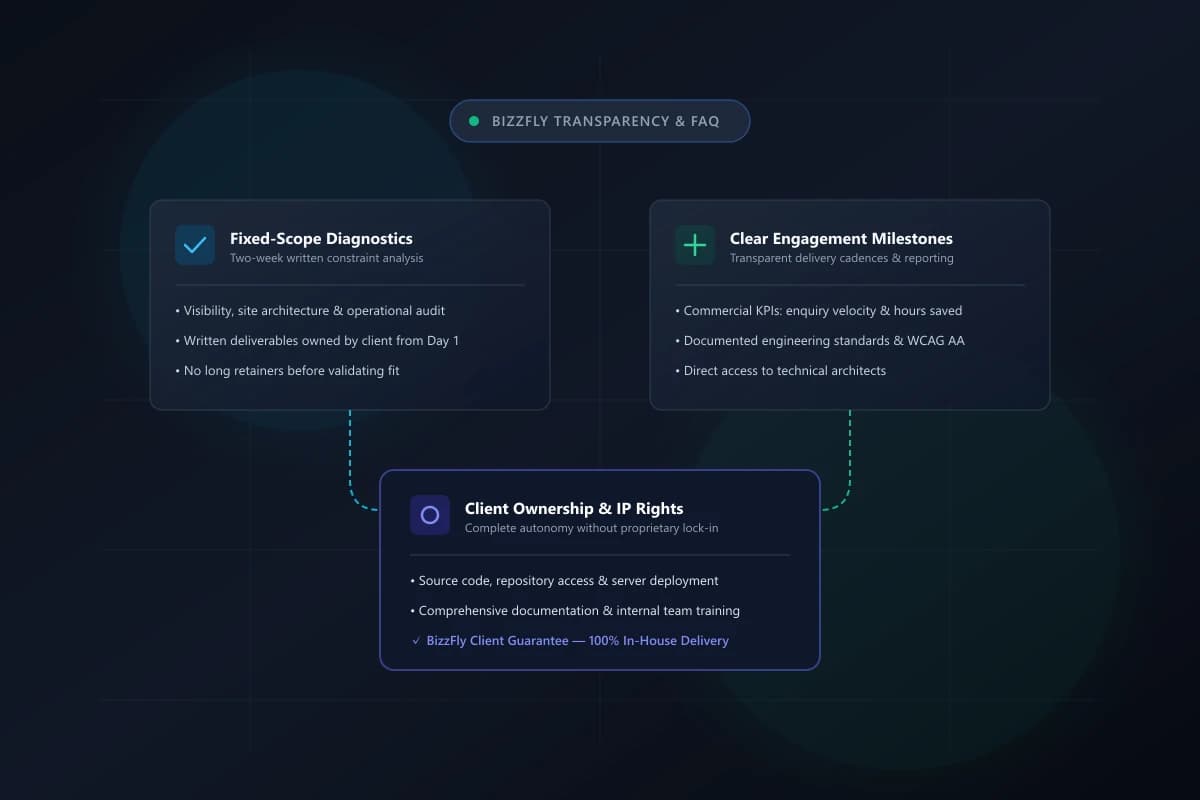
The pattern behind them is consistent. We prefer a small, fixed first engagement to a large open-ended one, we report against a stated hypothesis including when it fails, and we decline work we are not equipped for.

Four connected things: search and AI visibility, websites and digital experience, software and automation, and the analytics that measure them. Most engagements start in one and touch a second, because visibility and the ability to serve demand are usually the same problem.
Almost always with a fixed-scope diagnostic rather than a retainer. It establishes which constraint is actually binding, produces a written diagnosis you keep either way, and lets both sides judge the relationship before committing further.
Technical work can show measurable movement in indexing and impressions within about eight to twelve weeks. Content and credibility work usually takes longer to show commercially. Automation and software show a result as soon as the first process is in production, typically four to twelve weeks.
No, and anyone who does is describing something they do not control. What we commit to is removing the reasons a system would not rank or cite you, and reporting honestly on whether it moved.
You do, from the start. Code lives in your repositories and infrastructure in your accounts. Ownership arranged at the end of a project is ownership you negotiate for at the worst possible moment.
Yes, though the shape differs. Smaller engagements are usually a single focused project rather than an ongoing programme, because a programme needs enough scope each month to be worth the overhead of running one.
That is usually the better arrangement. Internal ownership of strategy and delivery with external depth for specific work outperforms either extreme, and it is the setup where recommendations actually get implemented.
Often, subject to what state it is in. The first step is an assessment of what exists, because inheriting a system without understanding it is how the second supplier repeats the first one's mistakes.
Everything above is how we say we work. Thirty minutes on a real problem is the fastest way to find out whether it is also how we behave — and it costs you nothing to check.